
When Municipalities Use Workplace Safety Laws to Respond to Public Criticism
Background
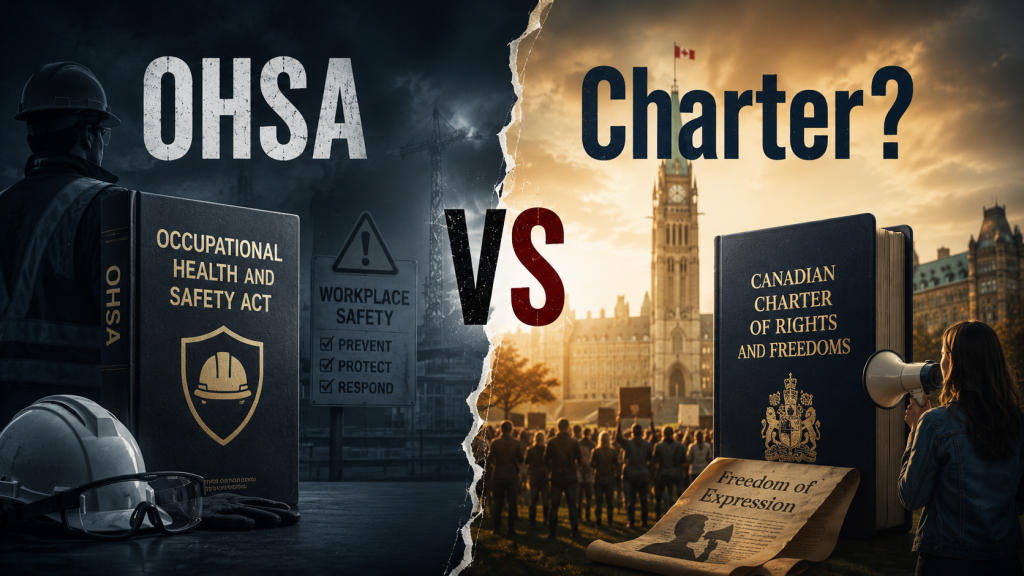
Across Canada, public institutions are increasingly using workplace safety language when responding to criticism from residents, journalists, and community advocates.
Terms such as “harassment,” “hostile conduct,” “unsafe environment,” and “employee wellbeing” are appearing more frequently in disputes involving criticism of municipal decisions, elected officials, enforcement actions, and local governance issues.
At first glance, that may sound reasonable. No one disputes that municipal employees deserve protection from genuine threats, intimidation, or abusive conduct. Ontario’s Occupational Health and Safety Act (OHSA) requires employers to address legitimate workplace harassment and safety concerns involving workers.
But an increasingly important democratic question is beginning to emerge: Where is the line between protecting employees and restricting lawful public criticism?
Further reading:
Ontario Occupational Health and Safety Act
https://www.ontario.ca/laws/statute/90o01
Canadian Charter of Rights and Freedoms — Section 2(b)
https://laws-lois.justice.gc.ca/eng/const/page-12.html
The Growing Tension
The Occupational Health and Safety Act governs workplace relationships involving employers, supervisors, and workers.
It was created to address real workplace safety concerns, occurring within employment settings and employer-controlled environments.
But when workplace safety language begins appearing in disputes involving political disagreement, journalism, advocacy, online commentary, or criticism from non-employees, constitutional and democratic questions can begin to emerge.
That distinction matters because criticism involving government decisions, municipal enforcement, public officials, transparency, and accountability generally receives strong protection under Section 2(b) of the Canadian Charter of Rights and Freedoms.
That protection is not unlimited, but it is significant and it’s important to note that criticism does not automatically lose constitutional protection simply because it is uncomfortable, reputationally damaging, or emotionally stressful for a public institution.
Public Roles and Public Scrutiny
That distinction can become especially important in public-facing municipal roles involving visible regulatory or enforcement authority. Municipal officials responsible for enforcement, building regulation, permitting, inspections, property standards, or other statutory decisions regularly exercise authority that directly affects residents, businesses, and property owners.
When criticism of municipal process or enforcement becomes framed as a workplace safety issue, the boundaries between employee protection and democratic scrutiny can become difficult to distinguish .
In democratic systems, scrutiny of how that authority is exercised is often an unavoidable part of public accountability. Threats, intimidation, and abusive conduct are always improper. But criticism of public decisions, enforcement actions, communication methods, or administrative processes does not automatically lose constitutional protection simply because it is directed toward an identifiable public official carrying out a public role.
Courts have repeatedly recognized that criticism involving government conduct, public administration, and the exercise of public authority sits near the core of protected democratic expression.
Ontario Cases Are Beginning to Test the Limits
Ontario courts have increasingly been asked to examine where workplace safety concerns end and protected democratic participation begins.
One important example came from Rainy River (Town) v. Olsen. In that case, a resident repeatedly sent hostile communications toward municipal officials. The Town attempted to rely partly on workplace harassment concepts and sought legal restrictions against the resident.
The Ontario Court of Appeal ultimately ruled that much of the conduct did not automatically fall within the scope of the Occupational Health and Safety Act because significant portions of the activity occurred outside the workplace context. The case demonstrated that workplace harassment law still has jurisdictional and constitutional limits, particularly where public criticism and democratic participation intersect.
Another Ontario example came from the case of Bracken v. Fort Erie (Town), where a citizen journalist and frequent municipal critic was issued a trespass notice that effectively barred him from Town Hall and council meetings after staff raised concerns about his conduct. The Ontario Court of Appeal later ruled that municipalities cannot rely on trespass powers in a way that bypasses Charter protections tied to freedom of expression and democratic participation.
The Court found that access to spaces like council meetings carries heightened constitutional importance because they are central to public oversight, political discussion, and holding elected officials accountable. The ruling reinforced that even disruptive, uncomfortable, or highly critical expression can receive significant protection in democratic spaces, and that municipalities must carefully justify any restrictions that limit a resident’s ability to observe or participate in local government.
These cases do not mean municipalities lose the ability to protect staff safety or respond to genuine threats. But they do show that courts continue to treat democratic participation, public criticism, and Charter rights as serious constitutional considerations.
Further reading:
Rainy River (Town) v. Olsen discussion
https://www.stringerllp.com/2017/09/19/court-of-appeal-rules-on-employers-obligations-to-protect-employees-from-harassment-and-violence-when-they-are-away-from-the-workplace/
Monkhouse Law — Bracken v. Fort Erie (Town) overview
https://www.monkhouselaw.com/court-of-appeal-clarifies-freedom-of-speech-in-government-workplaces-toronto-employment-lawyer/
CanLII — Zulynik v. The Corporation of the Township of Tiny
https://canlii.ca/t/k0r5p
The Chilling Effect
One of the biggest concerns raised by civil-liberties groups is what is often called the “chilling effect.”
People do not always stop speaking because speech is formally banned. Sometimes they stop because they fear escalation, legal pressure and costs, institutional consequences, reputational targeting, or ongoing conflict. Once residents begin wondering whether criticism itself may be treated as harassment, public participation can quietly begin to weaken.
That can affect communities over time. People become less willing to ask difficult questions, less willing to participate publicly, and less willing to challenge decisions involving public institutions.
Related Article: Councillor not sanctioned for reprisal against complainant (3/4)
Why This Matters in South Algonquin
These dynamics can become even more significant in smaller rural communities.
According to 2021 census data, many South Algonquin residents rely heavily on government transfer income, median after-tax incomes remain relatively modest, and a large portion of the population does not hold postsecondary credentials.
In communities with limited financial resources, limited institutional access, and smaller local media ecosystems, the practical impact of legal threats, institutional pressure, or prolonged disputes can become amplified.
Many residents simply do not have the time, money, confidence, or access to professional support needed to navigate complex municipal, legal, or administrative conflicts. In rural communities especially, even the perception of legal escalation can discourage public participation long before any court process ever begins.
That matters because democratic participation is not only about whether rights technically exist. It is also about whether ordinary residents realistically feel able to exercise them.
In South Algonquin, public discussions involving transparency, accountability, oversight complaints, municipal conduct, and freedom of information disputes have increasingly become part of local conversation. Whether residents agree or disagree on individual disputes, the broader democratic principle still matters.
Municipal governments are expected to protect staff safety and maintain respectful workplaces. But democratic systems also depend on residents being able to criticize government decisions, discuss local issues openly, and participate meaningfully in public life.
That balance is not always easy. Democratic accountability becomes more fragile when criticism and workplace safety begin overlapping without clear, objective, and proportionate boundaries.
Why This Should Matter to You
Most residents are not activists, journalists, or legal experts. Even though you may not be, these issues still affect you.
Municipal governments make decisions about roads, taxes, development, enforcement, recreation, infrastructure, and public spending and who has formal or informal access to public services paid for by the public purse. Public participation helps residents understand how those decisions are being made and whether systems are functioning fairly.
If people begin feeling that public criticism carries excessive personal or institutional risk, communities can become quieter, less informed, and less willing to engage openly. Over time, that weakens public trust.
In the end, democracy is not always comfortable. Residents complain. Journalists investigate. Public-facing officials who exercise enforcement or regulatory authority over residents will inevitably face public scrutiny regarding how that authority is used. That is not a workplace safety issue. That is evidence that local democracy is functioning exactly as intended.