Municipal Health Indicators in South Algonquin
To explore that question, we used a tool called the Municipal Health Checklist, developed by the Association of Manitoba Municipalities. The checklist is a municipal self-assessment tool developed by the Association of Manitoba Municipalities to help communities examine potential strengths and risks. AMM Tools Checklist
It looks at five areas: Population health, Tax base strength, Financial management, Cooperation with other communities, and Local democratic participation
Each section uses publicly accessible data about a community to assign points based on measurable indicators. Scores above zero suggest a healthy trend. Scores below zero signal areas where a community may be struggling. The checklist states:
“It is anticipated that some municipalities will score just above or below zero. In these circumstances, the checklist will indicate areas that are working well and areas that may benefit from further analysis.”
The result is not intended to apply a value judgement but rather to suggest areas where more attention are likely to impact outcomes.
⬇️ Population Trends
Key questions about how healthy our population is include: Is the population growing or shrinking? Are the number of children increasing? How quickly is the senior population growing?
Data from the 2021 Statistics Canada Census Profile for South Algonquin shows several important trends. Between the last census periods:
South Algonquin Stats Canada Report Here
- The overall population declined by about 4%
- The number of children under 18 dropped by 19%
- The senior population increased by about 12%
These changes point to a common challenge facing many rural communities: an aging population and fewer young families moving in. When the number of children declines, it often signals long-term demographic pressure. Schools shrink, local services become harder to maintain, and fewer working-age residents remain to support the local economy.
⬇️ The Tax Base
Municipal finances rely heavily on property taxes, so the second key indicator is strength of the municipal tax base. A healthy tax base usually shows: growing property values, a stable commercial sector, and balanced contributions between businesses and residents
Financial data in this section comes from the Annual Financial Information Return (FIR) that municipalities must submit to the Ontario government each year. Several trends appear in the data.
https://data.ontario.ca/dataset/financial-information-return-fir-for-municipalities
Property Values
Overall property values have increased slightly — about 4% since the last census. This number is positive, but modest. Further investigation into the data are required to reach conclusions.
Commercial Assessment
Commercial property assessments have declined by about 3%. This means businesses are contributing less to the tax base than before. When commercial assessments fall, the municipal tax burden often shifts toward residential property owners. As commercial assessments decline, residents carry a larger portion of the cost of running the municipality.
Residential Taxes
Residential property taxes have increased by roughly 20% since the last census period.
Much of this increase comes from higher tax rates rather than higher property values. In simple terms, residents are paying more because municipal rates have increased to support the budget.
MPAC property reassessments are expected across the province soon. Information conflicts on whether/how this will impact the tax base in South Algonquin.
➡️ Financial Management
How the municipality spends tax and grant money is important. This section includes questions such as: How much of the budget goes to administration? How much is spent on services and infrastructure? How much borrowing is occurring?
South Algonquin performed above zero on this marker highlighting that overall borrowing and spending patterns show areas of stability, the Township still carries financial pressures.
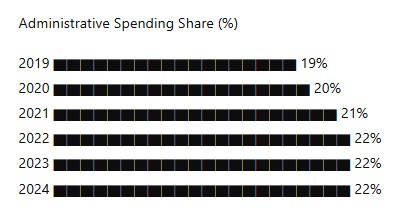
For instance, the Financial Information Return (FIR) data filed with the Province of Ontario shows that the share of South Algonquin’s spending devoted to general government administration has increased from roughly 19% earlier in the period to about 22% in recent years.
At the same time, the public salary disclosure data identifies that the number of township employees, has grown to three positions in 2024. While we are not suggesting, and the two trends do not prove, a direct connection, they both point to the same broader implication: Administrative costs are typically more fixed than many service costs. When municipal revenues fluctuate, councils may have fewer options to adjust administrative expenses compared with program spending.
⬇️ Cooperation with Other Communities
Small municipalities often benefit from shared services, regional economic development partnerships, joint planning initiatives, and shared staff or expertise. So another important measure of municipal health is how well we cooperate with neighbouring communities. These arrangements can help reduce costs and improve service delivery.
This section was a little more difficult to score as it is unclear whether the checklist was speaking of required cooperation or voluntary cooperation. In South Algonquin, some cooperation is required: for example, policing service costs are shared by communities. We found one example of voluntary regional cooperation documented in public council records in recent years.
The regional Community Safety and Well-Being Plan was developed jointly with neighbouring municipalities, but beyond that, collaboration appears limited. The result in this section reflects limited data.
A lack of cooperation can make it harder for small municipalities to attract funding, share expertise, and manage costs effectively.
⬇️ Local Democracy
The final section of the checklist looks at local democratic participation. This includes indicators such as:
- the number of candidates running for council
- whether elections are contested
- overall engagement in local governance
South Algonquin’s recent elections show some grassroots effort to increase participation, but like many rural communities, the number of candidates can be limited. When fewer people run for office, councils may experience longer and repeated learning curves as new members come on board and/or take on complex municipal responsibilities. When elections are uncontested, residents may have fewer opportunities to vote and to compare different approaches to governing the community.
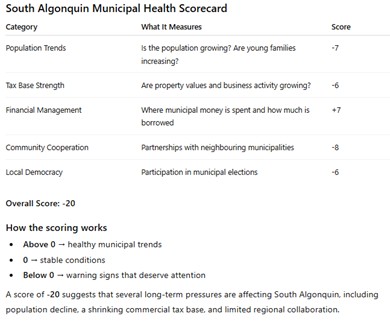
South Algonquin Municipal Health Scorecard
After combining all five sections, South Algonquin received a score of –20.
The checklist is intended as a discussion tool rather than a definitive judgement about a community. Positive scores suggest stronger municipal indicators and negative scores signal areas for conversation.
A score of –20 indicates several structural challenges:
- population decline
- an aging demographic
- a shrinking commercial tax base
- limited regional cooperation
Why does this matter?
These are not unusual challenges for rural communities. Many towns across Canada face similar trends. When communities trending downward pay attention to these signals, they can position themselves to take advantage of opportunities to adapt, plan ahead, and build the stronger future they want to see.