
How Do I Ask for Information from the Municipality?
Residents sometimes ask their municipality for records. These requests can involve reports, emails, contracts, or background documents related to council decisions.
In Ontario, access to municipal records is governed by the Municipal Freedom of Information and Protection of Privacy Act (MFIPPA). This provincial law creates a formal system that allows residents to request records while also protecting personal information. It also provides oversight and appeal rights if access to records is denied.
South Algonquin also has a separate process called the Routine Disclosure and Active Dissemination (RDAD) Policy. This policy allows certain records to be released outside of the formal Freedom of Information process.
Understanding the difference between these two systems can help residents decide how to request information.
The Formal Freedom of Information Process
Under MFIPPA (which became law in 1991), anyone can submit a Freedom of Information (FOI) request to a municipality. The law sets clear rules for how requests must be handled. For example:
- Municipalities generally have 30 days to respond.
- If records are withheld, the municipality must explain which legal exemptions apply.
- Certain fees may be charged to process the request.
- Most importantly, MFIPPA provides independent oversight.
If a requester disagrees with a decision, they can appeal to the Information and Privacy Commissioner of Ontario (IPC). The IPC is an independent provincial office that reviews disputes between requesters and public institutions and can order records to be released if appropriate.
Because of this oversight, MFIPPA provides a structured process with clear timelines, rules, and appeal rights if documents are omitted, withheld, or redacted inappropriately.
South Algonquin’s Routine Disclosure Policy
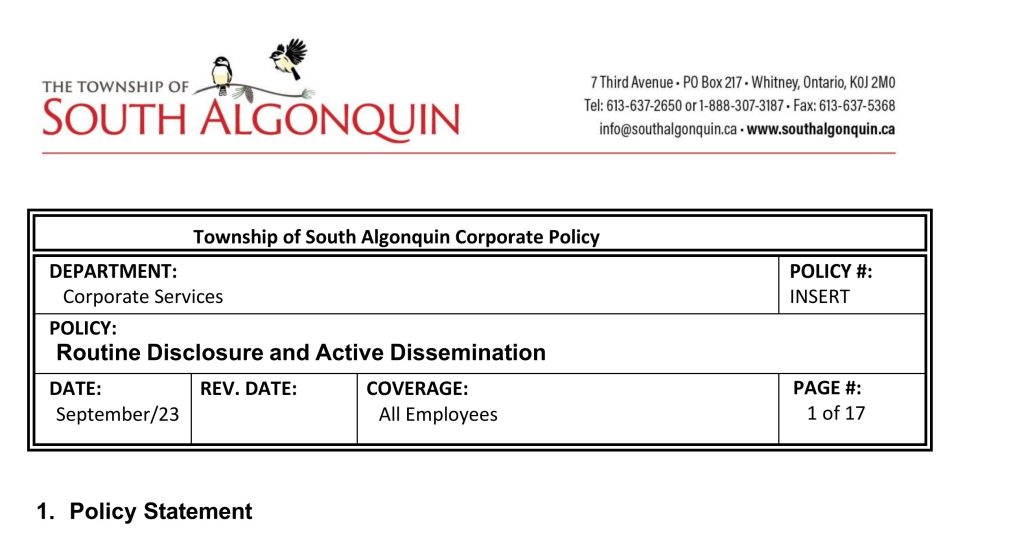
South Algonquin’s Routine Disclosure and Active Dissemination (RDAD) policy (2023-767), presented by staff and approved by council on October 4, 2023, allows certain records to be released without a formal FOI request.
Policies like this are common in municipalities. They are meant to make commonly requested records easier and less expensive to obtain. For example, records such as council agendas and minutes, bylaws, approved policies, and publicly available reports are often available directly on the township website. The RDAD policy can also be used to request public records that are routine, but not posted online.
In theory, routine disclosure can make access to simple records faster and reduce the need for formal FOI requests.
Key Differences Between the Two Processes
Although both systems provide access to information, they work differently.
The FOI process is governed by provincial legislation, while routine disclosure operates under municipal policy.
This difference affects the protections available to the requester.
Under MFIPPA,
- Requests follow rules set by provincial law
- Response timelines are defined
- Decisions can be appealed to the Information and Privacy Commissioner
- Under routine disclosure:
- Requests are handled administratively by the municipality
- There is no external appeal process
If a routine disclosure request is incomplete, incorrect or denied, the requester may need to submit a formal FOI request to access the protections provided by MFIPPA.
Why Municipalities Use Both Systems
Many municipalities maintain both systems because they serve different purposes.
Routine disclosure works well for records that are clearly public and frequently requested. The FOI process is designed for more complex requests, such as internal communications, background documents, or records that may involve privacy or legal exemptions.
Why This Matters
Providing access to public information is an important part of municipal transparency and oversight. Ontario’s Freedom of Information legislation was created to ensure that residents have a consistent process for requesting records and an independent avenue for appeal when access is denied.
Routine disclosure policies can make it easier to obtain simple public records. However, they are not the same as a formal FOI request.
When residents are directed toward an administrative process instead of the legislated FOI system, they may not have access to the protections provided under MFIPPA, including the right to independent review by the Information and Privacy Commissioner.
Understanding the difference between these two systems helps residents choose the process that best protects their right to access municipal information.