
When a Facebook Post Tries to Clarify a Law
Questions Surround South Algonquin’s Noise and Nuisance By-Law
A Facebook notice from the Township of South Algonquin has raised questions about its Noise and Nuisance By-law. While the Township states that some information online is “misleading,” the wording of the by-law and concerns raised before and after its passage provide additional context.
The By-Law: More Than Just Noise
On March 5, 2025, the Township of South Algonquin passed Noise and Nuisance By-law #2025-823.
The by-law regulates noise and odour, dust, light, and vibration. Under Section 5.0 of the by-law, no person shall:
- Create “objectionable odour”
- Emit dust or airborne particulate matter
- Direct light onto another property
These provisions apply at any time, unlike noise restrictions, which are limited to specific hours (11:00 PM to 7:00 AM).
The bylaw bans whistling and singing.
The bylaw goes so far as to list “persistent… whistling or singing” as prohibited noise, which highlights how broad and subjective it is. It does not define what counts as “persistent,” how loud is too loud, or where normal human behaviour crosses into an offence, instead relying on flexible, interpretation-based factors.
In practice, this means something as ordinary as someone singing or whistling outdoors could potentially be treated as a violation if heard from another property, raising concerns about how everyday expression is being regulated.
Concerns Raised Before and After Passage
Prior to the by-law being passed, written submissions were provided to the Township raising concerns about how the provisions could apply in practice.
In correspondence dated October 21, 2024, it was noted that:
- Septic pumping can produce temporary and unavoidable odours
- Construction activities can generate dust as a normal part of operations
- Routine lighting, such as exterior lights, may fall within the scope of the by-law
Following the by-law’s passage, legal correspondence dated April 7, 2025 raised additional concerns, including:
- Terms such as “objectionable odour” are not defined
- The by-law applies nuisance provisions at all times, unlike noise provisions
- Activities associated with normal operations may be subject to complaints
- The Township retains discretion in how nuisance provisions are interpreted and enforced
See letters sent to council here:
Context from Committee Discussion
A recording from an October 16, 2024 municipal meeting discussing the draft by-law includes comments from staff about how the by-law could be applied in practice.
During that discussion, the by-law was described as complaint-driven, with enforcement depending on whether a complaint is made.
In the same discussion, the clerk stated: “But it does become a sledgehammer for disputing neighbours.” This comment was made in the context of how the by-law may be used in situations involving neighbour disputes.
Written submissions and later legal correspondence similarly raised concerns about how broadly the nuisance provisions could apply and the level of discretion involved in enforcement.
Passed With Limited Changes
According to the April 7, 2025 correspondence:
- Township staff were directed to bring the by-law forward with minor revisions
- The by-law was passed at the March 5, 2025 Council meeting
- No substantive changes were made to address the concerns raised in earlier submissions
Then Came the Facebook Post
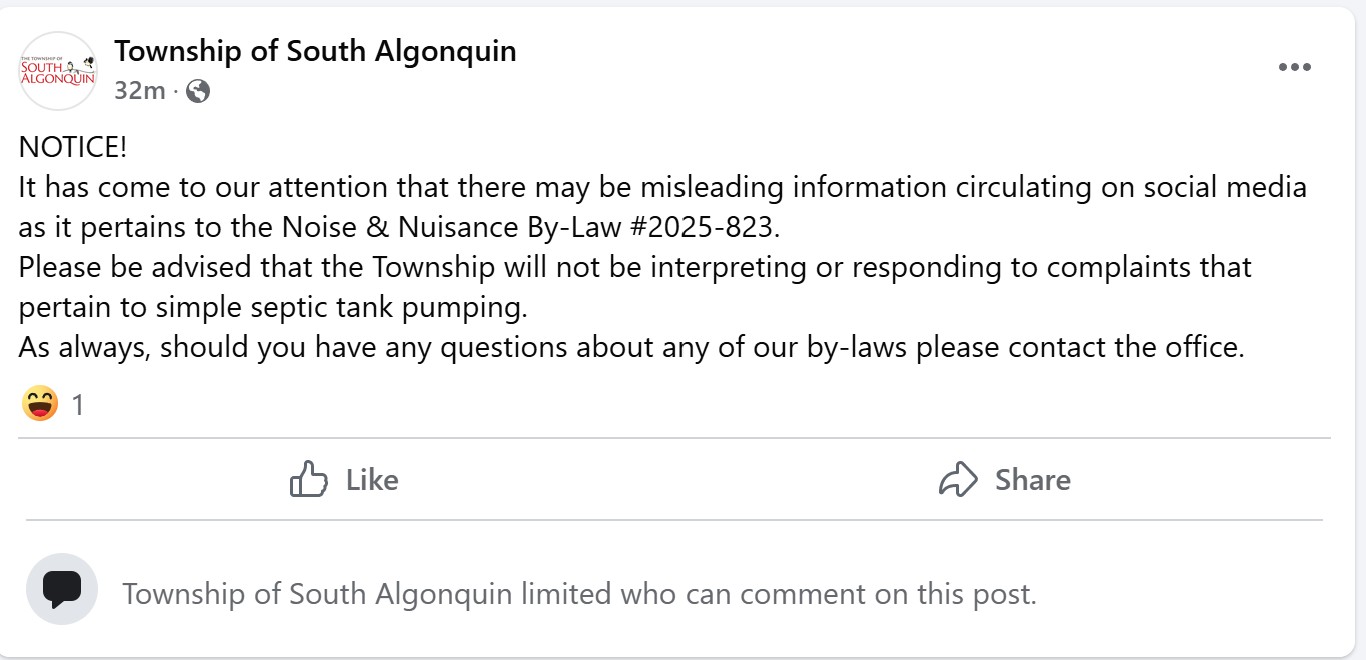
Following the by-law’s passage, the Township posted a notice on Facebook stating:
- There may be “misleading information” circulating online
- The Township will not interpret or respond to complaints related to simple septic tank pumping
“Please be advised that the Township will not be interpreting or responding to complaints that pertain to simple septic tank pumping.”
The post did not define what information was considered misleading or provide additional written guidance regarding other aspects of the by-law.
A Key Question: What Actually Changed?
The Facebook post introduces a clarification that does not appear in the by-law itself. Based on the records reviewed:
- The by-law text was not amended
- The nuisance provisions remain unchanged
- The clarification exists only as a social media statement
The post also does not address other areas raised in correspondence, such as dust or lighting.
If the bylaw was vague enough to require a social media post to clarify it, then it’s vague enough to be amended?
Why This Matters
Municipal by-laws are intended to provide clear guidance on:
- What activities are permitted
- What activities may result in enforcement
- How rules are applied
When a by-law contains broad or undefined terms—and clarification is provided outside the by-law itself—it may create uncertainty about how the rules will be applied in practice.
The Broader Question
The records show:
- Concerns were raised prior to adoption
- The by-law was passed with limited changes
- A clarification was later issued through a social media post
- Discussion at the committee level acknowledged the breadth of the by-law’s application
This raises a broader question about process. If a by-law requires clarification after it is passed, and especially if that clarification is communicated through non-legal channels like social media, should that clarification be reflected in the by-law itself?