
A Committee Member Was Appointed. Then Removed. The Process Is Unclear.

In July 2024, the Township established Terms of Reference for the Economic Development Committee. The document sets out the rules for membership, responsibilities, and removal. Members are described as “citizen” members who are appointed by Council, serve for the term of Council, and may be removed within a defined governance structure tied to Council authority and specific circumstances.
The Record is Clear
On May 22, 2025, the Committee moved forward with a recommendation to add new members, including Leah Geddes, a long-time volunteer with the local snowmobile association. She has worked on teams to bring funding to South Algonquin for trail maintenance and improvement and is regularly on the trails herself monitoring conditions and removing debris to maintain safety.
The transcript of that discussion reflects mixed views: some concern, balanced by support for broader representation. Geddes was described as bringing connections to recreational sectors such as ATVing and snowmobiling, and as someone who could contribute to economic development discussions beyond traditional accommodation-based tourism.
The recommendation was advanced to Regular Council and subsequently approved on June 4, 2025. Geddes began her tenure on June 18, 2025. Council held four Economic Development Committee meetings between June 18, 2025 and February 26, 2026. She was present at all of them.
On March 12, 2026, Geddes was advised by email that she did not meet a residency requirement and was removed from the committee by the Clerk.

This decision raises concerns, as it has been reported that some members of council and staff on the committee do not reside within the community. It invites the question:
Why is a volunteer being held to a higher standard than paid public officials?
The CAO’s email included a standard statement inviting her to follow up with questions or discuss the matter further.

In response, Leah followed up with the Township CAO and requested to attend the meeting.
She was subsequently barred from the March 18, 2026 meeting, preventing her from asking questions about the decision at the committee table.
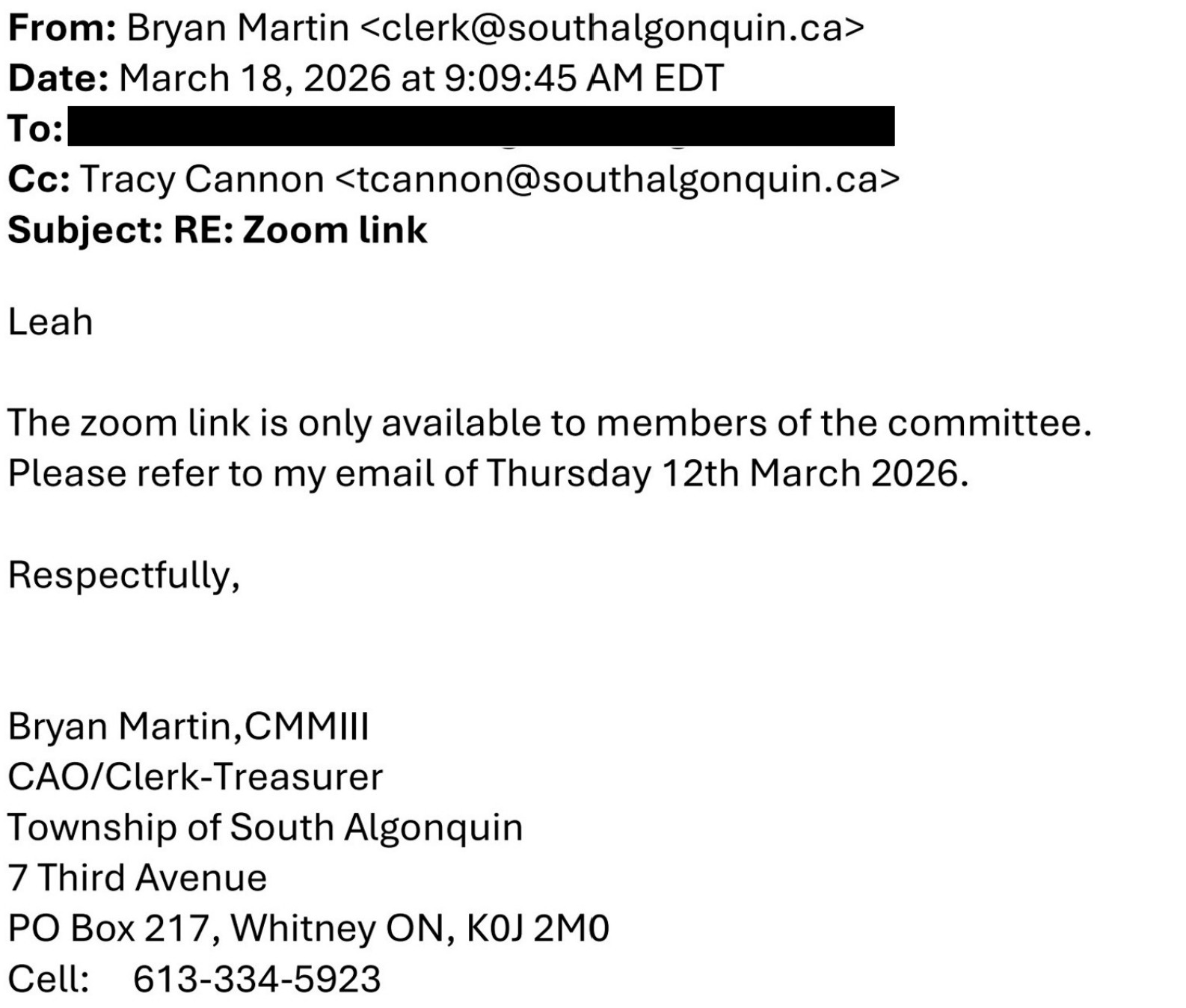
At the March 18, 2026 meeting, the decision was described as “administrative.” In response to a question about the process from a different committee member who had not been advised of the administrative removal, the clerk replied, “It’s administrative. It doesn’t have to be discussed. It should be managed under the policy so it was dealt with administratively.”
The reason communicated was residency. However, the Terms of Reference do not appear to explicitly require citizen members to reside in the Township, and the available records do not show how the residency concern arose, was assessed or applied, or whether Council reviewed it.
There is no clearly identifiable Council resolution in the materials reviewed that documents the removal. A review of Council minutes following March 12, 2026—including the March 18, 2026 meeting and subsequent available minutes—does not identify a resolution removing the member. There is no report setting out the rationale. The documents also do not indicate whether Geddes was provided with advance notice or an opportunity to clarify her residency status or otherwise respond before the decision was made.
Contradictory Outreach Following Removal
More notably, immediately after unilaterally removing Leah from the committee, the CAO sought to engage her expertise and request her assistance in what appears to be an unofficial capacity. This is particularly inconsistent given that trails are a central component of economic development—the very committee from which she had just been removed.

Why This Process Matters
Municipal advisory committees rely on consistency in how decisions are made and recorded. In this case, the appointment process is visible and traceable: a committee discussion, a recommendation, and Council approval. The removal, by contrast, is not tied to an equally visible decision record.
That gap creates uncertainty about how the governing framework is being applied, and whether it is being applied consistently.
It is also relevant that the Township has previously faced Integrity Commissioner findings involving reprisals against a community member and a group they represented. That does not establish retaliation in this case. It does, however, increase the importance of transparent and well-documented processes, particularly where the removed member was publicly supportive of community work connected to the South Algonquin Business Alliance.
Two subsequent requests for information through Routine Disclosure and the FOI process were denied.
The Issue
The issue is not whether a committee member can be removed. The governing documents clearly allow for that possibility.
The issue is whether the removal can be traced through a documented decision-making process that aligns with those governing documents.
When that connection is not visible, basic governance questions remain unanswered. What authority was exercised? What standard was applied? Who made the decision? Where is the official record? Was the process procedurally fair?
A formal complaint has now been submitted to the Township requesting clarification on the authority relied upon, the process followed, and the location of any official record of the decision. The purpose of that request is narrow and procedural: to determine whether the removal was carried out in accordance with the Terms of Reference and the Township’s broader governance framework.
If the record can be clarified, the issue resolves there. If it cannot, the question does not disappear. It moves to the next level of review.
At its core, this is about whether decisions affecting public participation are being made in a way that is visible, documented, and consistent with the rules meant to guide them.