Council Member Requests Sources for South Algonquin Matters Article
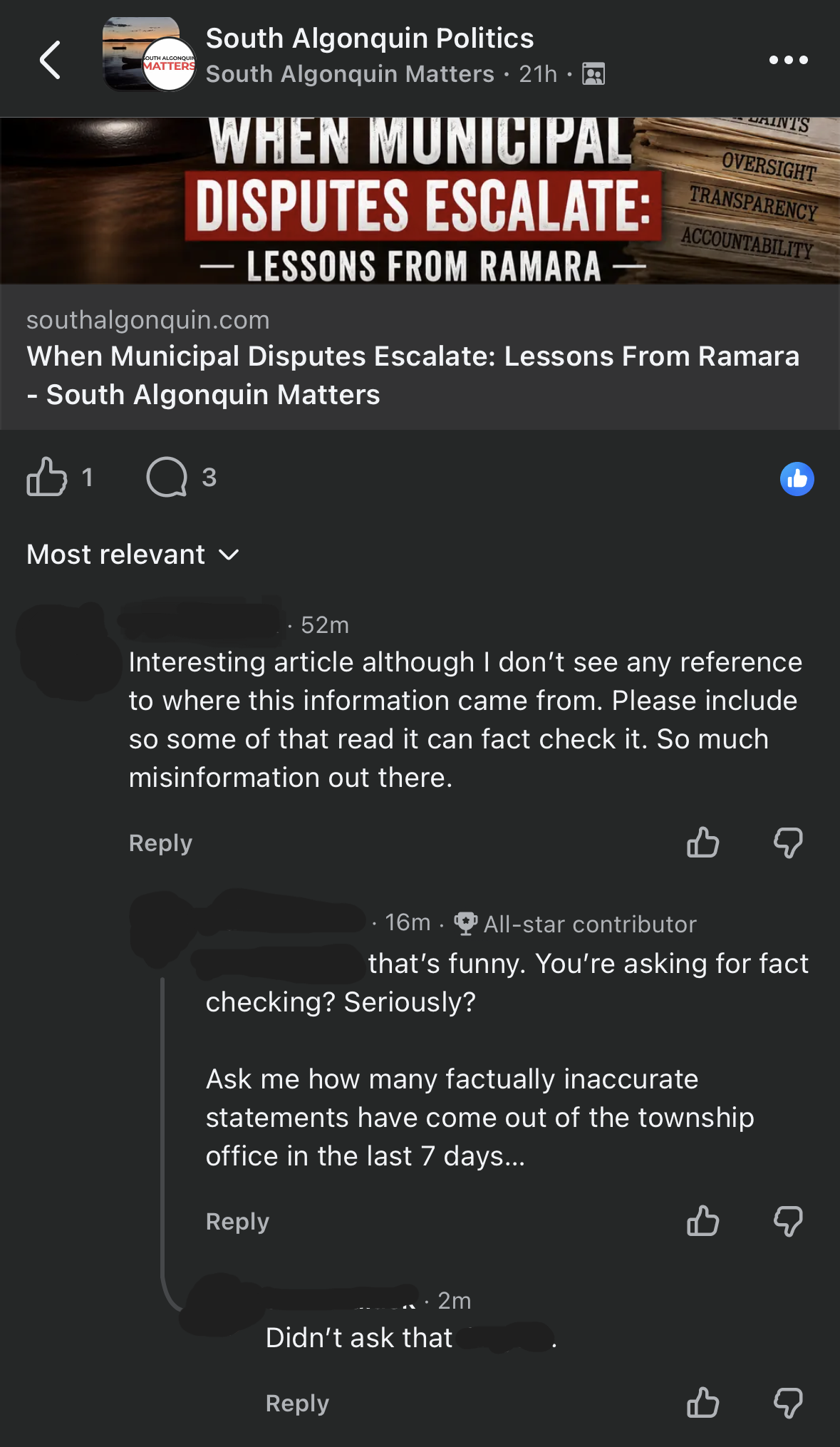
On May 16, 2026, a councillor for the Township of South Algonquin commented on a recent South Algonquin Matters article on social media, describing it as “interesting” while requesting supporting sources so readers could independently fact check the information.
Shortly afterward, a resident responded by pointing out what they viewed as irony. Their argument was simple: concerns about misinformation should apply equally to everyone, including the Township itself, particularly when residents have identified situations involving conflicting, incomplete, or inaccurate information from municipal sources.
So Where Does South Algonquin Matters Stand?
We believe there is merit to both perspectives. Both questions are valid.
The councillor is correct that sourcing matters. Readers should have the opportunity to independently review information, especially when discussions involve governance, public trust, public spending, or decisions that may shape the future of South Algonquin.
At the same time, the resident’s concern also deserves acknowledgment. There have been documented situations where residents have challenged information provided through municipal channels and questioned whether it was complete, accurate, or consistent.
For example, South Algonquin Matters has previously published articles examining questions related to municipal communications, interpretation of bylaws, committee governance, and property file administration:
- Flying Feathers: What Does “Grandfathered Obligation” Mean?
- Committee Membership: What the Rules Actually Say
- Emails Show Building Inquiry Sent to Non-Owner in Whitney Property File
- When a Facebook Post Tries to Clarify a Law
Whether readers agree with those articles or not, they illustrate an important principle: the need for evidence, transparency, and verification applies to everyone.
Why This Matters
Trust is built when information can be verified.
When public claims are supported by documents, videos, bylaws, policies, correspondence, or other evidence, residents can evaluate the facts for themselves rather than relying solely on competing opinions.
That principle should not apply only to critics of the municipality. It should apply equally to residents, media outlets, council members, municipal staff, and anyone else participating in public discussion.
If misinformation is a concern, then everyone should be committed to improving factual accuracy and supporting important claims with evidence whenever possible. Communities benefit when facts are easy to verify or refute.
Information Pollution
Waterloo Public Library has published an article explaining the differences between misinformation, disinformation, and malinformation, collectively sometimes referred to as “information pollution.”
https://www.wpl.ca/blog/misinformation-guide/
Misinformation contains unintentional mistakes, such as inaccuracies, errors, or satire that is mistaken for reality.
Disinformation involves deliberately false or manipulated information intended to mislead.
Malinformation involves the publication of genuine, often private information in ways intended to cause harm, such as doxing or the non-consensual sharing of private material.
Understanding those distinctions is important because not every disagreement or criticism falls into any of these categories.
Disagreement Is Not Misinformation
South Algonquin Matters also believes the term “misinformation” should be used carefully. Misinformation is not:
- Disagreement
- Questioning decisions
- Requesting accountability
- Advocating for a different outcome
In a democratic community, people will often interpret the same facts differently. That is a normal part of public debate. The focus should remain on evidence, transparency, and the ability of residents to examine information for themselves.
There should also be an appropriate mechanism for organizations to be notified of potentially inaccurate information and have those concerns reviewed and assessed fairly.
Leading by Example
Following the councillor’s comment, the article in question was updated with additional supporting sources and references.
Moving forward, South Algonquin Matters will make reasonable efforts to include supporting links, documents, and source material more consistently wherever practical.
We have also created a new submission page where residents, officials, staff members, and Township representatives can provide additional information, clarification, corrections, or alternative perspectives for review:
https://southalgonquin.com/submit-additional-information/
At the same time, it is important to recognize that many previously published South Algonquin Matters articles already contain substantial supporting material, including screenshots, videos, bylaws, policy references, official correspondence, meeting records, and other public documents that readers can review independently.
Scrutiny works best when it flows in every direction.
An Unexpected Positive
Ultimately, public discussion is healthier when everyone participates in good faith. In a way, the councillor’s comment revealed something important:
Township officials are reading the articles. That matters.
If councillors, senior staff, and municipal leadership are taking the time to follow independent reporting and public commentary, then these conversations are clearly relevant to the community.
We appreciate that engagement.
Public institutions should not be insulated from scrutiny, and neither should those who scrutinize them.
A community is strongest when everyone is willing to ask questions, provide evidence, consider new information, correct misinformation and participate in the conversation.
That appears to be exactly what happened here.